

The only AI game development tutorial 2026 you’ll need build, publish, and earn before lunch, even with a full‑time job
The artificial intelligence in video games market was valued at US2.88 billion in 2025 and is projected to reach US3.73 billion in 2026, growing at an impressive CAGR of 29.4%. A Google Cloud survey found that 97 percent of developers believe generative AI is reshaping the entire game industry. According to a BCG 2026 Global Gaming Report, approximately 50 percent of game studios now actively use AI in development. This AI game development tutorial 2026 will show you exactly how to get started as a complete beginner, using free and accessible AI tools that transform natural language prompts into playable games — no prior coding or artistic skills required.
- What Is Generative AI Game Development in 2026?
- How to Plan Your Game Concept Using AI Assistants in 2026
- Step-by-Step: Generating Game Visuals With AI Image Tools
- Creating Game Mechanics Through AI Code Generation
- Adding Audio and Sound Effects With AI Voice Tools
- Where to Publish and Earn From Your AI Generated Game
- Which AI Game Development Course Should Beginners Take in 2026?
- Your First Step Into AI Game Development Starts Today
- AI Game Development Tutorial
- Can a complete beginner with no coding experience build a game using AI?
- What is the best free AI tool for game development in 2026?
- Is it legal to sell a game I created with AI tools?
- How long does it take to make a game with AI versus traditional methods?
- Can AI generate 3D games or is it limited to 2D?
How to Plan Your Game Concept Using AI Assistants
Learn how to turn a rough idea into a structured game design document using AI in under 15 minutes.
Step-by-Step: Generating Game Visuals With AI Image Tools
Discover free AI art tools that create consistent characters, backgrounds, and animations from text descriptions.
Creating Game Mechanics Through AI Code Generation
No coding needed: how to use AI code assistants and no-code engines to build functional game logic from plain English.
Adding Audio and Sound Effects With AI Voice Tools
Simple tools for generating voice lines, background music, and sound effects without a recording studio.
Publishing and Earning From Your AI Generated Game
Where to publish your AI-built game and how platforms like the9bit turn creations into tokenized rewards.
What Is Generative AI Game Development in 2026?
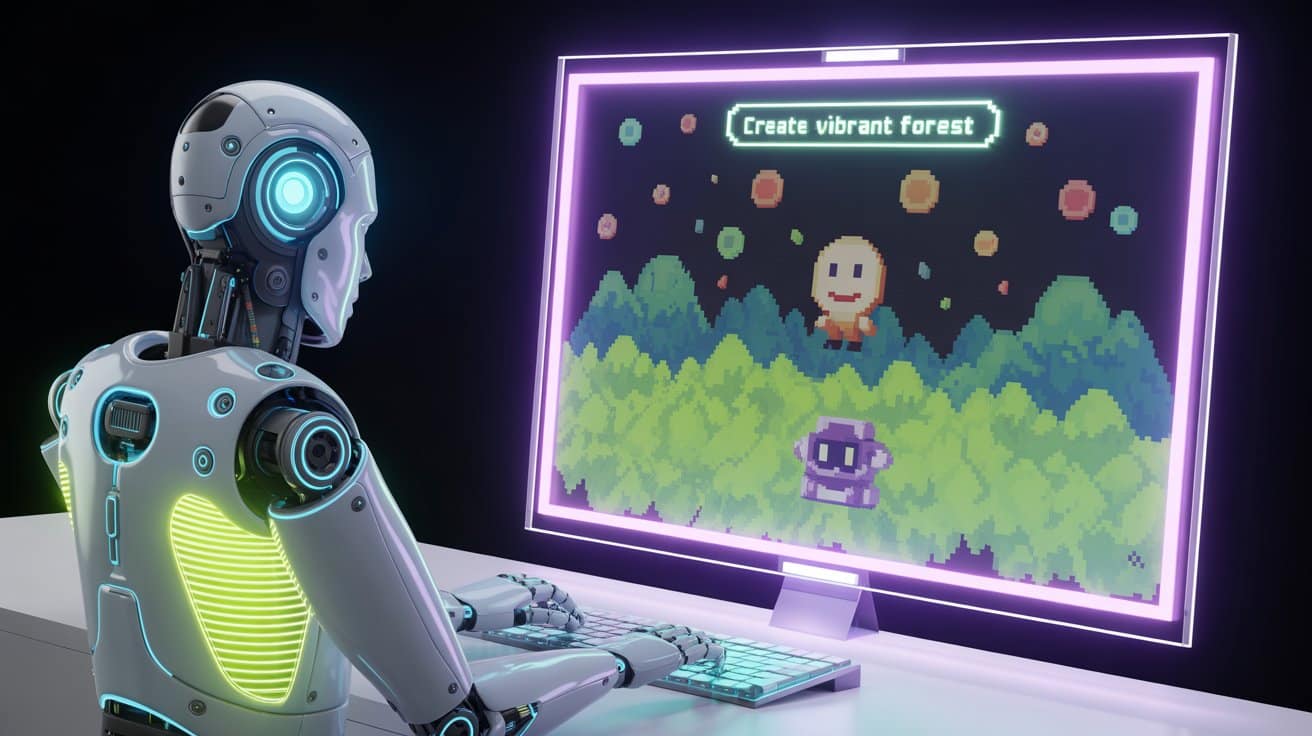
Generative AI game development is the process of using artificial intelligence systems to create or assist any aspect of game production — including storylines, mechanics, characters, environments, dialogue, code, audio, and animations — by converting natural language prompts into production-ready game elements.
In 2026, AI is no longer a futuristic concept but an essential tool in game development. According to GDC’s 2026 State of the Game Industry survey of 2,300 developers, 36 percent of game industry professionals are using generative AI tools as part of their job. Among business professionals and upper management in gaming, adoption reaches 58 percent. ChatGPT remains the most commonly used AI tool at 75 percent, followed by Google Gemini at 37 percent and Microsoft Copilot at 22 percent.
How to Plan Your Game Concept Using AI Assistants in 2026
Before generating any assets, you need a solid game plan. AI is excellent at expanding ideas, but it cannot replace your creative direction. Spending 10 to 15 minutes thinking through your concept will make every AI interaction far more productive.
Open an AI assistant such as ChatGPT, Claude, or Google Gemini. Tell the AI your preferred genre, target audience, core gameplay loop, and visual style. For example: *”I want to build a 2D puzzle platformer set in an abandoned laboratory. The player solves physics-based puzzles by moving blocks. Target audience is casual mobile gamers.”*
The AI will return a structured game design document (GDD) that outlines mechanics, level progression, character descriptions, and suggested visual themes. For advanced users, tools like AG2 enable a swarm of specialized AI agents — story agent, gameplay agent, visuals agent, and tech agent — to collaboratively generate a comprehensive design proposal.
Key decision: Your genre sets the foundation for everything else. Different genres need different mechanics, pacing, and art direction. A first-person shooter requires different AI assistance than a narrative-driven RPG. Be specific about your genre from the start.
Step-by-Step: Generating Game Visuals With AI Image Tools
Here are the leading free tools for generating game visuals with AI in 2026:
| Tool | Best For | Cost |
|---|---|---|
| Rosebud AI | Rapid prototyping from text prompts | Free |
| Makko AI | 2D games with consistent art styles | Free tier |
| ParallaxPro | 3D browser games with real physics | Open source |
| Leonardo AI | High-quality backgrounds and environments | Free tier |
| DeepMotion | Character animation from video | Free tier |
Rosebud AI is a free, browser-based AI game maker that turns your ideas into games from text prompts. Simply describe your game concept, and its AI game engine will generate the initial code to bring your game to life. It also features an AI image generator for custom game assets, bringing visuals and gameplay together in one place.
Makko AI launched in April 2026 with a unique approach: you describe what you want and immediately generate concept art, characters, backgrounds, objects, and animations — all in a consistent art style through its Collections system. Since launch, Makko has attracted over 4,000 creators generating game art. As CEO Jeremy Bird explains: “Most people who want to make a game are not blocked by the code. They are blocked by the art”.
ParallaxPro takes a different approach — it is an open-source, browser-based 3D game engine where AI generates games that run on real infrastructure with WebGPU rendering, rigid body physics, skeletal animation, and an ECS architecture. The AI does not need to reinvent the wheel; it just places entities and attaches scripts.
For AI game dev tutorial for beginners, start with Rosebud AI. Everything runs online with no downloads or coding required. A complete beginner can describe a simple platformer concept, tweak the mechanics, and share a playable version with friends the same day.
Creating Game Mechanics Through AI Code Generation

With visuals ready, it is time to make the game functional. You do not need to memorize complex syntax. Tools like GitHub Copilot, Cursor AI, and Claude Code can generate working game code from natural language prompts.
For beginners, the simplest path is to start with a no-code game engine that has built-in AI assistance. GDevelop is used by over 400,000 monthly creators — gamers, hobbyists, teachers, and professionals. It uses AI to help you build your game step by step, even with no prior experience.
For those who want to code with AI assistance, the eaisports CLI allows you to build browser games directly from a text description. Run eaisports build -d “a space shooter with power-ups” and the AI will generate a fully playable browser game that you can preview locally and deploy.
For advanced Unreal Engine developers, NVIDIA has documented reliable AI coding workflows for Unreal Engine 5. The core challenge is the context gap — failures rarely come from weak code generation but from missing constraints such as code patterns, branch differences, or internal conventions. NVIDIA works with game studios to improve AI reliability by combining syntax-aware code indexing, hybrid search techniques, and GPU-accelerated vector search infrastructure.
Most of the survey’s respondents — 81 percent — said their most common use for AI is research or brainstorming, followed by daily tasks and code assistance at 47 percent each, and prototyping at 35 percent.
| Development Task | AI Role | Time Saved |
|---|---|---|
| Writing game logic | Code generation from prompts | 70-80% |
| Debugging errors | AI-powered error analysis | 60-70% |
| Prototyping mechanics | Rapid iteration with AI | 80-90% |
| Optimizing performance | AI-driven code refactoring | 50-60% |
Adding Audio and Sound Effects With AI Voice Tools
A game’s audio layer is often overlooked, but AI tools make sound design accessible to everyone. Use ElevenLabs for AI-generated character voice lines with natural intonation, Soundraw or Boomy for procedural background music that adapts to gameplay intensity, and Riffusion for instant sound effects from text descriptions.
FreeAI Builder has demonstrated that in interactive fiction and AVG scenarios, AI-powered content creation efficiency can increase by 10 to 20 times, while overall development costs are reduced by more than 70 percent.
Important Note: While AI adoption is growing, sentiment remains mixed. According to GDC’s 2026 survey, 52 percent of game developers believe generative AI is having a negative impact on the game industry — up from just 18 percent two years ago. Only 7 percent said it has a positive impact. The most critical advice: use AI as a tool to enhance your creativity, not as a replacement for original thinking. The highest-quality AI-generated games come from creators who direct, curate, and refine AI outputs rather than accepting them passively.
Where to Publish and Earn From Your AI Generated Game
Once the game is stable and fun, deployment is the next milestone. For Web2 distribution, publish to platforms like itch.io, Steam Direct, or mobile app stores via GDevelop, Unity, or Unreal Engine exports.
For those exploring Web3 integration, publishing on a platform like the9bit enables immediate monetization through tokenized rewards. the9bit is an independent AI-powered gaming platform that combines AI Game Development (AIGD), an AI Assistant, and a tokenized economy into a single, user-friendly platform. Every action — playing, purchasing, creating content, deploying games, or running a community Space — is AI-assisted and value-generating, earning loyalty points that convert into liquid $9BIT tokens.
Key platform features for AI game creators:
- AI Game Development (AIGD): Create and publish games from prompts, powered by AI
- Tokenized Economy: Over 23 percent of $9BIT tokens allocated directly to gameplay, mining, and community incentives
- Spaces: Community hubs that evolve into AI-native game studios
- Web2 Simplicity: Fiat payments, auto-wallets, and seamless UX combined with Web3 liquidity
The generative AI in gaming market is projected to grow from 1.79billionin2025to2.21 billion in 2026 at a CAGR of 23.1%. Early creators who enter the market now are positioning themselves for significant advantage as the industry scales.
Which AI Game Development Course Should Beginners Take in 2026?
The best AI game development courses in 2026 focus on practical, project-based learning rather than pure theory. Look for courses that teach you to:
- Use AI assistants like ChatGPT and Claude for game design and documentation
- Generate art assets with tools like Midjourney, DALL-E, or Leonardo AI
- Write and debug code with GitHub Copilot or Cursor AI
- Publish completed games to distribution platforms
Free resources include tutorials from the9bit GitBook, Google AI Studio for vibe coding, and AG2 documentation for agent-based game design. Many courses are also available on YouTube and platforms like GUVI, which offers dedicated guides on generative AI for game development.
For structured learn AI game development pathways, consider platforms like Coursera, Udemy, or specialized bootcamps. However, the most effective AI game development guide is hands-on: pick a simple game idea and build it from start to finish using the tools described above.
Your First Step Into AI Game Development Starts Today
Analysts expect the artificial intelligence in video games market to hit $10.71 billion by 2030, following a surge to $2.21 billion in 2026 at a 30.2% CAGR. These numbers are not predictions — they are already happening. The barrier to entry has never been lower. You do not need a computer science degree, years of art training, or a large budget. All you need is an idea and the willingness to experiment.
The difference between those who succeed and those who do not is not talent or resources — it is simply starting. Pick one AI tool from this guide today, describe your first game idea, and press generate. Your journey from player to creator begins with that single click.

