

Is Your Career Ready for the Shift? A Deep Dive into the Future of Work with AI
If you walk into any Starbucks in Mid Valley or a hipster cafe in Penang these days, you’ll likely overhear someone talking about how ChatGPT or some new generative tool just saved them four hours of grunt work. It feels like overnight, the goalposts have moved. We went from “learning how to use software” to “learning how to talk to intelligence.” The truth is, the Future of Work with AI isn’t a distant deadline anymore—it’s the current operating system. A lot of people feel a bit of “tech anxiety,” wondering if their role will still exist in two years. But if we look at the patterns, it’s not about losing jobs; it’s about the “death of the boring parts” of our jobs. We are moving away from being “doers” of repetitive tasks and becoming “curators” of AI-generated outputs.
How AI is Changing the Way We Work Everyday

Many people assume that automation only affects factory lines or data entry. However, the reality of AI changing the way we work is much more interesting. It’s moving into the “creative and strategic” zones.
Think about a typical marketing executive in KL. Previously, a campaign would require days of market research, another few days for drafting copy, and a week for design. Today, AI improving work efficiency means the research and first drafts are done in minutes. The human’s job has shifted to “quality control”—making sure the brand voice is authentic and the cultural nuances (especially in a diverse place like Malaysia) are spot on. AI provides the raw ingredients; we provide the secret sauce.
What Does the Market Actually Want from Us Now?
There is a lot of talk about AI workplace skill requirements, and honestly, it’s not as technical as you might think. You don’t need to be a data scientist. Instead, the market is looking for “AI Fluency.”
It’s like when the internet first became a thing. You didn’t need to know how fiber optic cables worked; you just needed to know how to Google things effectively. In the AI and the future workplace context, your value lies in your ability to bridge the gap between a business problem and an AI solution. This includes:
- Strategic Questioning: Knowing exactly what to ask the AI to get a high-quality result.
- Emotional Intelligence: Handling the human side of things—empathy, negotiation, and leadership—that code simply cannot replicate.
- Adaptability: Being okay with the fact that your favorite tool today might be obsolete by next Tuesday.
AI and Human Collaboration in 2026
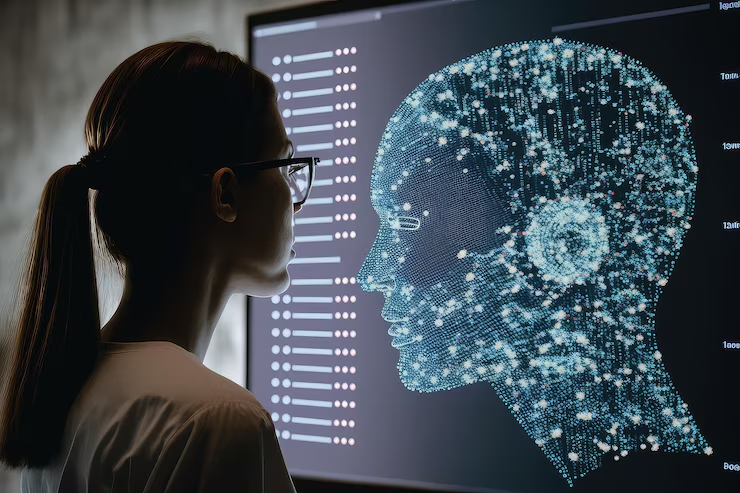
The most successful teams right now aren’t the ones with the most people, but the ones with the best “sync” between humans and machines. AI and human collaboration is becoming the standard.
Take a look at companies like QIAI. The focus isn’t just on having powerful algorithms, but on how those algorithms empower a person to do more. It’s about “Augmented Intelligence.” When you have a system that can predict market trends or handle complex scheduling, the human team is free to focus on high-level relationship building.
This leads us to the AI automation and employment debate. Yes, the “hands-on” execution roles are shrinking, but the “architect” roles—the people who design the workflows and manage the AI ecosystem—are exploding. In Malaysia, we are seeing a huge push toward digital transformation because companies realize that if they don’t automate the routine, they can’t afford to innovate the future.
AI Remote Work Trends and Global Competition
One of the most exciting parts of the Future of Work with AI is that it has completely broken the office walls. We used to talk about “Working from Home,” but now it’s more like “Working from Anywhere with an AI Assistant.”
Current AI remote work trends show that since AI can handle a lot of the coordination and administrative overhead, small Malaysian teams can now compete on a global scale. You don’t need a massive back-office anymore. A lean team, powered by the right tech stack, can manage international clients as effectively as a traditional firm in Singapore or London. This is a massive opportunity for local talent to earn “global currency” while staying in their hometown.
Making Peace with the Machine

At the end of the day, AI’s impact on work is mostly about leverage. Imagine trying to build a house with just your bare hands versus using power tools. AI is the ultimate power tool for the mind.
It’s okay to feel a bit overwhelmed by the AI future work trends. The pace is fast. But remember, the goal isn’t to be faster than the AI—that’s a losing battle. The goal is to be the person who knows how to drive it. Whether you are a freelancer, a corporate climber, or a business owner, the “Future of Work” is simply about being more human, while letting the AI be the machine.
Harvard Business Review – How AI Will Change the Future of Work: A comprehensive look at the shift from task-based work to insight-based work.
Forbes – The Top 10 Future Of Work Trends For 2026: Insightful predictions on how AI and remote work are merging to create a new global talent market.
MDEC (Malaysia Digital Economy Corporation) – Digital Economy Blueprint: Official documentation on Malaysia’s strategic direction for AI adoption and workforce upskilling.
Confused about the Future of Work with AI? Let’s Clear Things Up.
We’ve answered the most common questions about staying relevant and productive in 2026.

