

How to build games using AI tools take that game idea you’ve been sitting on for years and turn it into a paying reality in under an hour
You do not need to be a programmer to build a video game anymore. The global AI game creation process has become more accessible than ever, with tools that handle everything from art assets to game logic. If you want to build games with AI, you need a clear workflow: concept planning, asset creation, scripting, level design, and publishing. This guide walks you through each stage with real tools and actionable steps. To build games using AI tools in 2026, follow a five-step workflow: (1) plan with ChatGPT/Gemini to generate design documents and daily schedules; (2) generate assets using tools like Meshy for 3D or Makko for 2D; (3) write game logic with AI coding assistants like Godogen or GDevelop AI; (4) design levels using AI procedural generation; and (5) publish using no-code AI game builders like CodeWisp. This AI game development workflow requires zero manual coding.
What does the AI game creation workflow look like in 2026?
From design documents to asset generation, AI scripting, level design, and publishing — understand each stage.
Which AI game asset generators deliver real production quality?
Breakdown of Meshy, Makko, and Tripo — generation times, formats, and real-world performance data.
Can AI scripting tools for games replace manual coding?
Exploring OpenGame, Godogen, and how AI handles GDScript, scene trees, and visual verification.
What role do platforms like The9bit play in AI-native game ecosystems?
How integrated economies and AIGD features are turning creators into studios with real rewards.
Which AI Game Asset Generators Deliver Real Production Quality?
AI game asset generators work as follows:
| Tool | Best For | Input | Output Formats | Generation Time | Key Feature |
|---|---|---|---|---|---|
| Meshy.ai | Full 3D pipeline | Text, Image, Multi-view | FBX, GLB, OBJ, STL, BLEND | 10–60 seconds | Auto-rigging + 500+ animations |
| Makko AI | 2D games | Natural language | Characters, backgrounds, spritesheets | Real-time | Collections style consistency |
| Tripo3D | Base mesh generation | Text, Image | OBJ, STL | Seconds | PBR textures via Uni-Rig |
| Ludo.ai | API asset pipeline | Text prompts | Sprites, 3D models, audio | Via API | MCP integration for IDEs |
Beyond 3D assets, Makko AI launched its 2D game studio in April 2026, helping anyone turn a game idea into cohesive 2D art assets without traditional drawing or animation workflows. Over 4,000 creators have used Makko to generate game art across characters, backgrounds, and animations.
Where does The9bit fit here? The9bit does not build its own asset generators — it does something smarter: it aggregates them. AIGD (AI Game Development), the platform‘s AI-assisted creation layer, provides a single interface where creators can source and manage assets generated from these specialized tools without context switching. A character concept generated in Meshy, a background set from Makko, and audio assets from Ludo.ai can all be directly imported into a The9bit project and published in minutes rather than weeks. The platform sees over 230,000 daily active users generating on-chain activity, and as creators build games using these assets, every engagement — from playtesting to full launch — feeds into a reward loop where both creators and players earn $9BIT tokens for their contributions. In other words, The9bit turns asset generation from a standalone task into the first step of a monetized publishing journey.
Can AI Scripting Tools for Games Replace Manual Coding?
AI scripting tools for games have advanced significantly, allowing developers to generate functional game logic from natural language descriptions. The difference between how to create a game using AI tools with scripting versus without is substantial — scripting tools give you deeper control, while no-code builders prioritize simplicity.
Here is how the leading AI coding tools compare:
| Tool | Platform | Code Handling | Output | Best For |
|---|---|---|---|---|
| Godogen | Godot Engine 4 | AI assembles complete projects | Working 2D/3D Godot game | From text to full game |
| OpenGame Framework | Web/HTML5 | GameCoder-27B LLM | Playable web games | Agentic end-to-end generation |
| Claude Code Game Studios | Any | 49 agents, 72 skills | Full studio pipeline | Professional team emulation |
| GDevelop AI | Browser | Visual logic + AI | Multiplayer platformers | Hobbyists and teachers |
The9bit takes a different approach. Rather than building a generative LLM competitor, the platform integrates these scripting capabilities into its broader ecosystem. By the time you bring a Godogen-assembled project into The9bit‘s AIGD layer, the heavy lifting of gameplay logic is already handled. What The9bit adds is the distribution engine: a built-in publishing pipeline, an audience of over 7 million registered users, and tokenized incentives that turn playtesting into paid engagement. The platform’s upcoming AIGD toolkit expansion in 2026 includes deeper integrations with AI-assisted publishing, meaning creators can take scripted game projects from external tools and immediately launch them into a live, revenue-generating gaming economy. The9bit is not trying to replace dedicated AI scripting tools — it is creating the marketplace where those scripts become playable, profitable games.
How Do No-Code AI Game Builders Simplify Publishing?
For creators who want to avoid coding entirely, no-code AI game builders offer the most accessible path to the AI game development workflow. These platforms let you describe your game in plain language and watch AI build it in real time.
| Platform | Input Method | Supported Genres | User Base | Publishing |
|---|---|---|---|---|
| CodeWisp | Text description | Sandbox, racing, tower defense, platformer | 22,000+ games | Browser, remixable |
| Overdare Studio Agent | Natural language (Unreal 5) | Mobile-optimized 3D | Within Krafton ecosystem | Chat-based editing |
| GDevelop | Visual + AI | Platformers, shooters, strategy | 400,000+ monthly creators | App stores direct |
| Rosebud | Text-to-game | 2D/3D, RPG, interactive stories | Growing community | Cross-platform |
Among no-code platforms, The9bit stands apart because it was designed from day one with publishing and monetization at its core. Unlike stand-alone builders that stop at generating a playable demo, The9bit‘s AIGD feature is a creation layer embedded inside a fully operational gaming economy. When you build a game using The9bit’s AI-assisted tools, you are not just prototyping — you are publishing directly to a platform that already generates over $2.25 million in total revenue, with more than 1.44 million unique active wallets and 8.1 million on-chain transactions since its August 2025 launch.
More than 38,000 users have collectively received over 32.8 million 9BIT tokens based on their platform contributions, meaning games launched on The9bit enter a pre-existing, token-powered economy where creator traction converts directly into token rewards. The platform has already surpassed 7 million users, and its Web3.5 model — combining Web2 ease of use, an AI intelligence layer, and Web3 ownership — ensures that no-code builders can skip the hardest part of game development entirely: building an audience from scratch.
What Are the Best AI Level Design Tools in 2026?
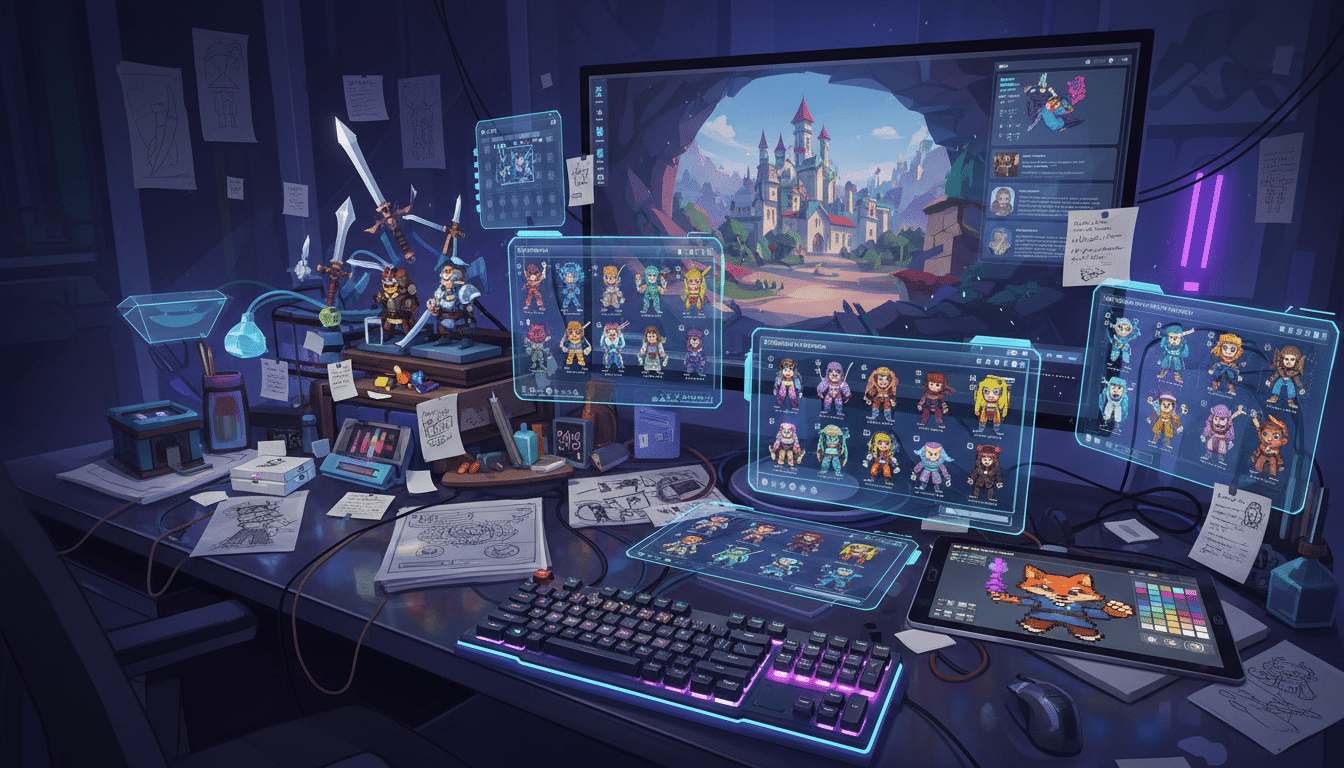
AI level design tools streamline the process of creating playable environments without manual placement. Traditional level design for a commercial game can take months of iterative testing. AI accelerates this by generating procedural layouts, enemy spawn points, and difficulty scaling automatically.
Ludo.ai released its API and MCP (Model Context Protocol) beta in April 2026, enabling indie developers and studios to integrate asset creation directly into daily workflows, from AI assistants and IDEs to custom tools, build systems, and automated pipelines. The system allows creators to prototype a feature, call for placeholder art, animate it into a spritesheet, generate a coordinated sound set, and iterate — all from the same environment.
AI level design tools integrate with larger publishing ecosystems. The9bit takes this integration further. On The9bit, creators can use AI-assisted tools through the AIGD layer to build and publish entire games, unlocking a “creator-to-player” reward loop where creators earn token rewards from game traction and players earn points for engagement. Every time a player discovers a community-created level, plays it, and generates on-chain activity, both the player and the creator are compensated in $9BIT tokens — a closed-loop incentive system that traditional level design tools lack entirely. The9bit is not building AI on top of theory — it is layering AIGD on top of a live, revenue-generating gaming economy with millions of users. These milestones form the foundation for 2026, where AI shifts the platform from engagement to creation and from consumption to ownership.
The question is no longer “can I build a game with AI?” — it is “how quickly can I start?” With AI game asset generators like Meshy producing full 3D characters in seconds, AI scripting tools for games like Godogen assembling complete Godot projects, and no-code AI game builders like CodeWisp and Overdare turning plain English into playable experiences, the barriers to game creation are collapsing. Platforms like The9bit are taking the next step, integrating these AI tools into live economies where creators earn real rewards for their work.
Your game idea is waiting to become reality. Choose your entry point from this workflow and start building today.